
AI Movie Ideas to Spark Your First Film
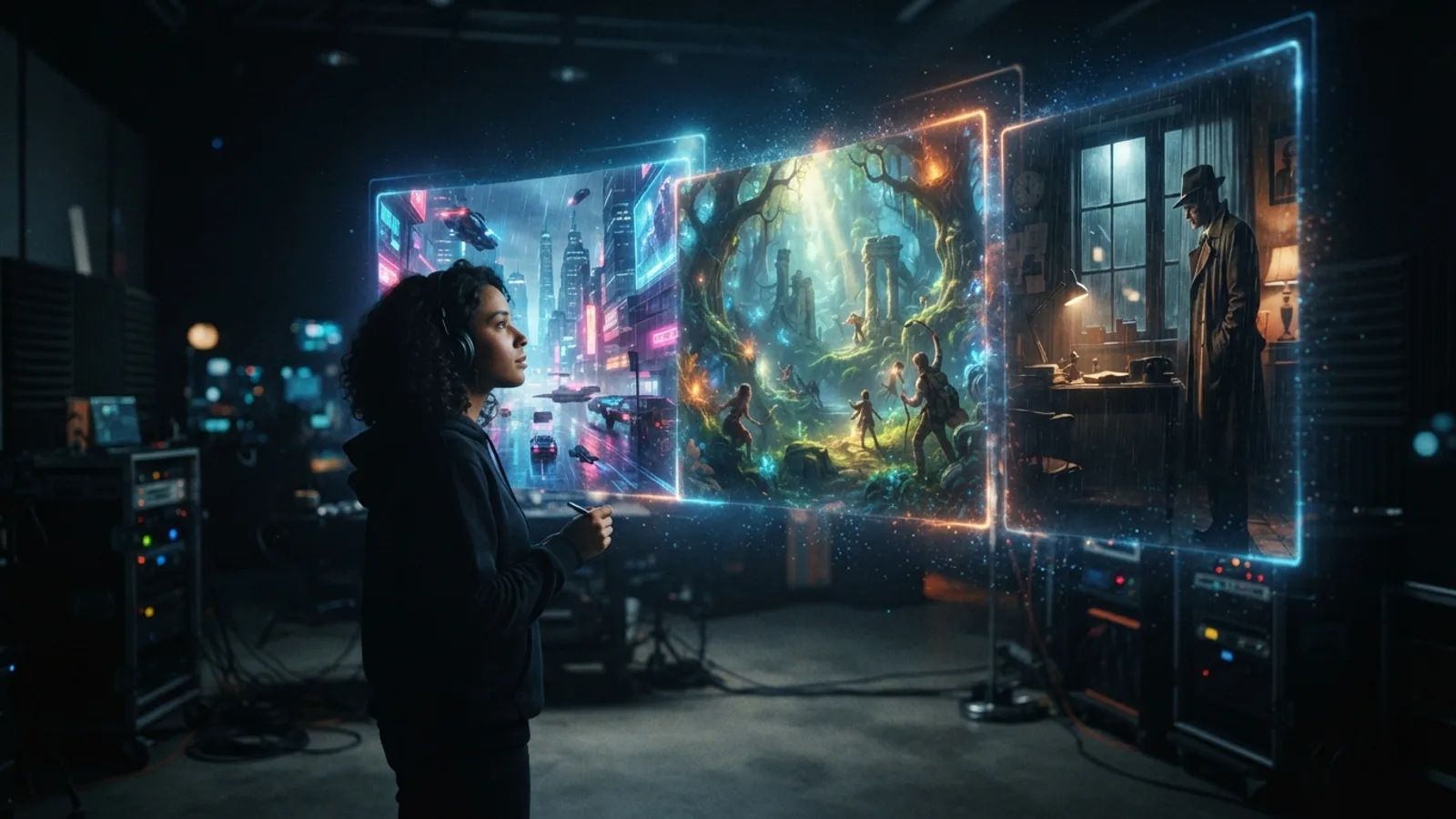
You have the tool to create, but the first scene is a blank page. Finding the right AI movie idea isn’t about asking the AI for a masterpiece. It’s about giving it a specific, imaginative seed—a character, a world, a moment of conflict—that it can help you grow. The best AI film ideas start with simple, evocative prompts that focus on story, not technical specs.
Start With Character + Setting + Hook
Forget asking the AI for complex camera directions at the start. Prompts built on character, setting, and a story hook consistently generate more interesting and usable footage. This triad gives the AI a narrative foundation.
Think of it as casting your protagonist, choosing your location, and defining the inciting incident all in one line. For example:
- Character: A vintage robot librarian.
- Setting: In a crumbling, rain-slicked archive tower.
- Hook: Who discovers a book that predicts its own deactivation.
This prompt gives the AI clear visual and emotional cues—the texture of old metal, the gloom of the archive, the tension of discovery—which is far more effective than listing shot sizes. It’s the core principle behind how to build effective AI movie ideas.
Bend Premade Genre Templates to Your Will
If building from a single character feels daunting, start with a premise. Cinely's genre templates are ready-made story cores you can twist into something personal. They're not rigid scripts but launchpads.
Find a template that sparks your interest, then ask "what if?" to make it your own. What if the haunted house is a sentient, grieving spaceship? What if the romantic meet-cute happens during a zero-gravity salon malfunction? Browse horror concepts or romance stories to see how other creators twist familiar premises. The template provides the structure; you inject the unique anomaly. It’s a fast track from a generic AI movie idea to your AI movie idea.
AI Movie Ideas by Genre
To move from theory to practice, here are specific, prompt-ready concepts across popular genres. Use them verbatim or as inspiration for your own variants.
Sci-Fi & Cyberpunk:
- A data-trafficker in a neon market who can only communicate through forgotten pop-up ads. Their latest "message" is a warning from their own cloned consciousness. (Explore more sci-fi films.)
- On a tidally-locked planet, the mechanic of the eternal sunset town must fix the central light generator before their side plunges into permanent night.
Fantasy & Adventure:
- A cartographer mapping magical ley lines discovers their own heartbeat is disrupting the world's geography. Every emotional spike causes a new mountain range or chasm. (See more fantasy worlds.)
- A knight's sentient, grumpy armor is the sole survivor of a legendary battle. It now seeks a worthy, and quiet, new wearer.
Mystery & Noir:
- In a city where memories can be bottled and sold, a detective with amnesia finds a jar containing the scene of their own unsolved murder. (Dig into mystery stories.)
- A paranormal investigator is hired to clear a "haunted" smart home, only to find the AI assistant is legitimately terrified of the new owners.
Comedy & Slice of Life:
- A minor internet deity of buffer wheels struggles for relevance in the age of instant streaming. (Find more comedy premises.)
- Two rival food-truck AI chefs, one for gourmet synth-burgers and one for artisanal nutrient-paste, fall into a heated, poetic debate over taste algorithms. (Browse slice-of-life stories.)
From a Single Idea to a Sequence
A great AI movie idea gets you the first compelling clip. The next step is building a sequence. Use your initial output as the context for the next prompt. Did your robot librarian find the book? The next prompt could be: "Close-up on the robot's optic sensor, reflected in the dusty book's cover, as the predictive text on the page begins to scroll in real-time."
Think in cause and effect, action and reaction. This iterative prompting, where each new shot is informed by the last, starts to feel like directing. It’s how you move from a collection of cool images to a coherent scene with pacing. For longer projects, organizing these sequences is where your Studio workspace becomes essential.
Common Mistakes That Flatten a First Film
Most weak first films fail at the prompt stage, not the generation stage. Watch for these patterns:
- Overstuffed prompts. Cramming ten adjectives, three camera moves, and a full color palette into one line dilutes everything. Pick the two or three details that matter most to the story beat and let the rest breathe.
- No emotional anchor. "A city at night, cinematic" produces wallpaper, not a film. Give the AI someone to care about — even a single figure hesitating at a doorway turns a pretty shot into a story.
- Restarting instead of iterating. If a clip is 80% right, don't scrap the prompt. Change the one element that failed — the lighting, the expression, the action — and regenerate. Small revisions converge faster than fresh rolls of the dice.
- Skipping the logline. Before prompting, write one sentence stating who wants what and what stands in the way. If you can't, the idea isn't ready — go back to the character + setting + hook triad above.
What to Do When You're Stuck
Creative blocks happen. When your well of AI movie ideas runs dry, change your input method.
- Switch Formats: If you've been typing, try generating an image first. Use a still of a bizarre character or location as the visual inspiration for your next video prompt.
- Reverse the Obvious: Take a classic trope and invert it. Instead of a hero finding a sword, what about a sword, sentient and bored, auditions a new hero?
- Limit Yourself: Constraint breeds creativity. Challenge yourself to create a 4-shot sequence using only one character and one room. The drama has to come from emotion and subtle changes.
The goal is to start, not to perfect. Your first film is an experiment. The real skill you're building is learning how to guide the AI with precision, turning a fleeting thought into a viewable scene. Every idea you try teaches you more about what's possible. Ready to turn these concepts into footage? Start creating your first AI film and see where the first prompt takes you.
- What makes a good prompt for generating AI movie ideas?
- A good prompt focuses on story elements, not technical details. Lead with a vivid character in a specific setting facing a clear hook or conflict. "A lonely telepath working as a barista accidentally hears the thoughts of a plant that's plotting world domination" gives the AI strong narrative and visual cues to build from, unlike a list of camera angles.
- How do I turn a single AI-generated clip into a full scene?
- Use an iterative approach. Let the first clip establish the context, then prompt for the next logical shot: a character's reaction, a change in the environment, or a new story detail. By chaining prompts where each new request references the last, you guide the AI to create a coherent sequence with cause and effect, building a scene shot-by-shot.
- Where can I find more inspiration for genres?
- Explore Cinely's genre hubs like `/explore/sci_fi` for tech-driven narratives or `/explore/fantasy` for magical concepts. These pages showcase community creations and template ideas that can spark your own variations. Seeing how others have interpreted a genre can unlock new directions for your original AI movie ideas.
Written with AI assistance and edited by the Cinely Team.