
AI Storyteller: Any Story Told Aloud, With Voices
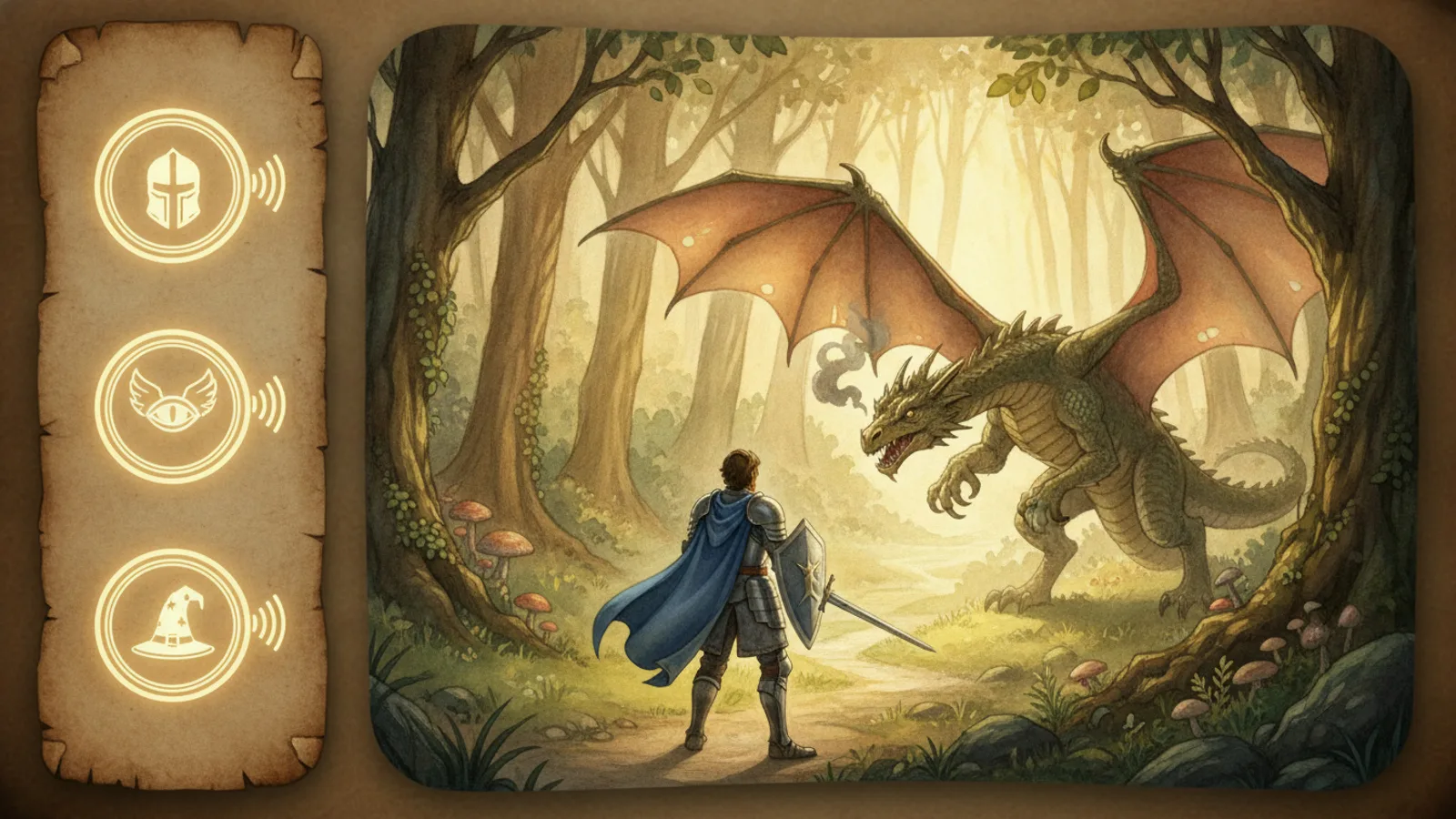
An AI storyteller is a tool that writes a story and then tells it out loud: a narrator reads it, the characters speak their own lines, and you listen instead of reading. Cinely's AI audio story maker does exactly that from one line of text, gives every speaking character a voice of their own, draws a picture for each part, and hands you a 3, 5 or 10-minute video plus the MP3.
Most tools sold as an "AI story reader" stop at text-to-speech: paste text, get one voice reading it. A storyteller does more of the work. This guide covers what to look for, how Cinely handles each part, and how to write a prompt that gives you a story worth hearing.
What a good AI storyteller should do
Before picking a tool, check it against five things that make a story sound told rather than read:
- It writes to a length. A story should end when the time you asked for ends, not stop mid-scene. Cinely writes the story to fill 3, 5 or 10 minutes.
- It separates the narrator from the characters. A child's line should not come out in the same voice as the narration. Here each speaking character gets their own voice, and keeps it to the last line.
- It lets you choose the narrator. The narrator carries most of the story, so you should pick that voice yourself.
- It shows you the script first. You should read what will be said before you pay for it.
- It gives you a file you can keep. An audio file for a playlist or the car, a video for YouTube or TikTok.
How Cinely's AI storyteller builds a story
Open Cinely's audio story generator and type what the story is about. Three kinds of input work:
- An idea: "A lighthouse keeper's cat who guards the lantern through a storm."
- A classic's name: the form itself suggests "The Little Mermaid" or "The legend of the dragon in the lake".
- Your own text: paste a short story (up to 2,000 characters) and it is read as written.
Then pick the length. The story is cut into parts of about 25 seconds, each with one picture: 7 pictures for 3 minutes, 12 for 5, 24 for 10. The writer invents up to five speaking characters (the narrator is not one of them), and each part holds the narration plus up to four spoken lines.
The story is written in the language you type in, or in the language you pick from the list. So a prompt in Spanish gives you a story told in Spanish.
Voices: one narrator, a voice per character
This is where an AI storyteller earns the name. For the narrator you choose between Auto, Warm woman, Gentle man, Grandmother and Grandfather, a voice from Cinely's voice catalog, or your own voice as the AI narrator: "Record my voice" asks for two short recordings, you talking naturally and one consent sentence read aloud.
The characters' voices are chosen for you, by who they are. A child gets a higher voice, an elder a lower one; the writer's description of each character decides male or female. No character shares the narrator's voice, two characters do not share one voice while others are free, and each keeps the same voice in every part. On the preview you see the cast with the voice each one got.
Pictures and format
Every part is read over one still illustration that slowly zooms in while you listen. Five looks are available:
| Look | Suits |
|---|---|
| Storybook | Warm painted children's-book pages |
| Watercolor | Quiet, airy tales |
| Anime | Adventure, school stories, fantasy |
| Cinematic | Painterly realism with film lighting |
| Dark tale | Mysteries and ghost stories, eerie but never gory |
The same characters are drawn the same way in every picture, and no text is drawn into the images. Pick landscape for YouTube or portrait for Shorts and TikTok; subtitles of every spoken line are optional.
Read every part for free, then approve
Nothing is charged when you press "Preview story". The preview shows the title, the cast with their voices, and every part: what the narrator says, what each character says, and what the picture will show. To change a part, ask the Agent. Only when you press "Make the story" are credits spent.
Pricing is flat: 30 credits a minute in every look and with every voice.
| Length | Pictures | Credits |
|---|---|---|
| 3 minutes | 7 | 90 |
| 5 minutes | 12 | 150 |
| 10 minutes | 24 | 300 |
If a part cannot be voiced, its share of the price is refunded; a story with no voiced part at all is refunded in full. New accounts get welcome credits and daily check-in credits, and more are available as coin packs or with Premium.
When it is done you download two files: Video (MP4) and Audio only (MP3). Videos from free accounts carry a small "Made with Cinely" badge; Premium removes it. If the MP3 is what you are after, here is how to turn a short story into an audiobook MP3.
How to write a prompt a storyteller can tell
A storyteller needs a story, not a topic. "A story about friendship" gives the writer nothing to hold on to. Give it four things:
- Who: one main character with one trait. "A shy hedgehog who collects lost buttons."
- Where: a place you can picture. "A village at the bottom of a well."
- What goes wrong: the problem that drives the story. "The last button belongs to the moon."
- How it should feel at the end: cosy, eerie, funny, bittersweet.
Then match the settings to the story. A ghost story told by the fire wants Dark tale, a lower narrator such as Grandfather, and 5 minutes to build suspense. A fable for a seven-year-old wants Storybook and 3 minutes. If you want a quiet story for a child to fall asleep to, the guide to bedtime audio stories made with AI goes through lengths, voices and story ideas for that.
What it is not
Be clear about the limits before you start. It is not a full audiobook tool: the longest story is 10 minutes and pasted text is capped at 2,000 characters, so a novel will not fit. It is not animation: the pictures are stills with a slow zoom. If you want moving scenes, an animated story video or an AI bedtime story video is the better fit.
The rules are the same as for everything on Cinely: original characters, no real people or celebrities, no copyrighted characters, no sexual content. The prompt filter checks your text before anything is charged.
If what you want is a story told aloud, with a cast instead of a single reader, make an audio story with AI: type one line, read the preview, and decide.
- What is an AI storyteller?
- An AI storyteller is a tool that writes a story and tells it out loud, instead of only showing text on a screen. On Cinely you type an idea or paste a short story; a narrator reads it, each character speaks in a voice of their own, and every part is illustrated. You get a 3, 5 or 10-minute video and the voices alone as an MP3.
- How is it different from a text-to-speech story reader?
- A text-to-speech reader reads your text in one voice. Cinely's audio story maker also writes or shapes the story to the length you chose, splits it into parts, gives up to five speaking characters their own voices (by their age and sex) next to the narrator, and draws one picture per part.
- How much does it cost?
- 30 credits a minute, whatever look or voice you pick: a 3-minute story is 90 credits, 5 minutes 150, 10 minutes 300. The preview of the whole story is free and you read it before anything is charged.
- Can I use my own voice as the narrator?
- Yes. Choose "Record my voice": you make two short recordings, one of you talking naturally and one consent sentence read aloud, and the narrator then speaks with your voice. The characters keep the voices chosen for them.
- Can I paste a story I wrote?
- Yes, up to 2,000 characters. A pasted story is read as written; an idea or the name of a classic tale is written into a full story for you, in the language you type in.
Written with AI assistance and edited by the Cinely Team.