
UGC Script Templates and Hooks for Every Ad Angle
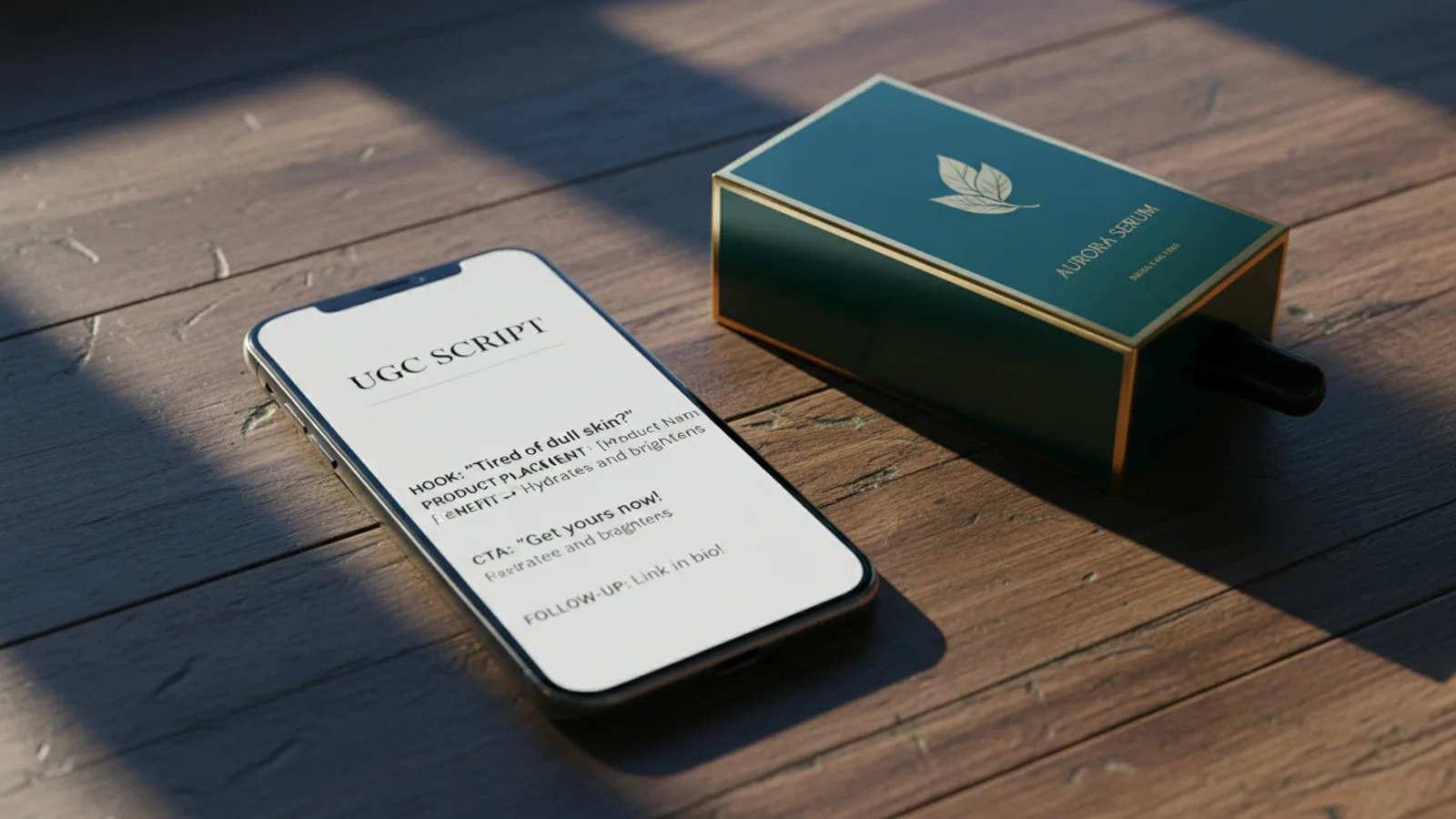
A UGC script is a short, spoken, first-person script cut into beats: a hook in the first three seconds, one or two beats that show the product in someone's hand, and a call to action. The templates below give you that structure for five proven angles at 15, 30, 45 and 60 seconds, with hook formulas and the rules an honest UGC ad script follows. They are the same beats Cinely's AI UGC video ad maker uses when it writes a script for you.
Most UGC scripts fail for one of two reasons: the first line sounds like an advert, or the middle tries to say too much. Fixing both is easier when you write in fixed-length beats instead of paragraphs.
The unit of a UGC script: one 8-second beat
Write the script as a list of beats, not as prose. One beat is one shot of the creator talking to the phone, about 8 seconds long, and it carries one or two short sentences, 18 words at most. That is roughly the pace people actually talk at on camera, with room to breathe and to hold the product up.
| Length | Beats | Spoken words (about) | What fits |
|---|---|---|---|
| 15 s | 2 | 30–36 | Hook + call to action |
| 30 s | 4 | 60–70 | Hook, two middle beats, call to action |
| 45 s | 6 | 90–105 | Hook, four middle beats, call to action |
| 60 s | 8 | 120–140 | Hook, six middle beats, call to action |
Two short on-screen text cards sit on top of the spoken lines: the hook card on the first beat (eight words or fewer) and the call-to-action card on the last (four words or fewer: "Link in bio", "Shop now", "Follow for more", "Use my code").
UGC hook formulas
The hook is the beat that decides whether anyone sees the rest. It can keep the product out of the shot; its job is to make a specific viewer think "that's me". Five formulas that fit in one beat:
- The honest opener. "Okay, here's my real take on [product] after using it all week." Card: My honest take.
- The problem, out loud. "If your [thing] always [annoying problem], stay with me for a second." Card: Tired of [problem]?
- POV. "POV: it's 7 a.m., you're late, and [familiar moment]." Card: POV: [moment].
- The number. "Three things nobody tells you about [product category]." Card: 3 things to know.
- The parcel. "It finally came. I've been waiting for this one." Card: It's here.
Two checks before you keep a hook: could a stranger say it to a friend without sounding like a commercial, and does it name a situation narrow enough that the right viewer recognises it? "This changed my life" fails both.
Five UGC script templates, beat by beat
Each template lists the beats in order. A shorter video keeps the hook and the call to action and takes the middle beats from the top: a 30-second script uses the first two middle beats, a 45-second script the first four.
1. Honest take
- Hook: what you thought before trying it, or "okay, here's my real take".
- Context: why you tried it, what you used before.
- Demo: the product held up close and shown in use: the texture, the button, the fit.
- What I liked: one specific thing, shown while you say it.
- What to know: one honest caveat or who it is not for. This beat is what makes the format credible.
- Verdict: your overall opinion, product by your face.
- Call to action.
Example 30-second script for a travel mug: "Okay, real take on the mug everyone keeps asking me about." / "I wanted one I could throw in my bag without thinking twice." / "Look, the lid clicks shut, and I can turn it upside down." / "If that's your kind of mug, link in bio."
2. Unboxing
Hook (the box just arrived) → opening the box on camera → first look, the product turned in the hand → first use and your reaction → one detail up close → first impression → call to action. Best when the packaging is part of the product.
3. Problem → solution
Hook (the problem, specific and relatable) → what you tried before and why it didn't work → the find, the product brought into the shot → how it works, step by step → the difference, shown rather than claimed → who it's for, as an opinion → call to action. Strong for gadgets, cleaning and organising products.
4. Three reasons
Hook ("three reasons I keep this on my desk") → reason one → reason two → reason three (each a different detail or use, shown) → a small bonus → the three in one breath → call to action. Works when a product has separate, visible benefits.
5. POV
Hook ("POV:" and a moment the viewer knows) → the situation plays out → the product enters as the answer → using it, with a reaction → how the moment ends now → a knowing line to the viewer who has been there → call to action. Told from the viewer's seat, the way creators talk.
The middle: show, don't promise
From the second beat on, the product should be named and in the shot, held close with the label to the lens, or used on camera. Then write what can be seen. "The pump gives exactly one drop, look" works; "my skin is glowing now" does not.
An honest UGC ad script:
- gives an opinion ("what I like is…", "for me…", "what I noticed…");
- only states facts the brand gave you (a price, a size, an ingredient) and nothing it didn't;
- never claims personal results that can't be shown in the clip (kilos lost, acne gone, money made);
- never quotes a customer, doctor or expert, and never says "clinically", "guaranteed" or "number one";
- never names a competitor, and uses no fake urgency ("only 3 left") unless it is true and in the brief.
These are not just style choices. TikTok and Meta review ads for exactly these claims, and when the creator is an AI creator, a first-person result would be a claim nobody experienced. Label AI-made creators as AI-generated where you post.
The post caption
Write the caption last, in the creator's voice: one or two short sentences, then five to eight hashtags covering the product category and the format (for example #unboxing or #honestreview). The caption repeats the call to action for people who read before they tap.
Let Cinely write the first draft
If you would rather edit than write from scratch, the AI UGC video ad maker drafts the whole script from one product photo:
- Add the product photo and the product name, and, optionally, what the creator should mention and your call to action.
- Pick an AI creator (or let Cinely pick), an angle (or auto), where it is filmed and a length of 15, 30, 45 or 60 seconds, in any of 17 languages.
- Read the free preview: the hook card, every spoken line, the call-to-action card and the post caption with hashtags.
- Approve to render it: 30 credits per 8-second clip in Standard, 60 in Cinematic, so a 30-second ad is 120 credits in Standard. A clip that fails is refunded. New accounts get welcome and daily check-in credits; packs are on the credits page.
The writer follows the same rules as above: only facts from your brief, opinions instead of results, no testimonials. The AI UGC ad walkthrough covers the product photo, creators and pricing in more detail, and UGC video examples by product type shows which angle and setting suit which product.
Want to test two hooks against each other? Make the same product in two angles at 15 seconds, run both, and only turn the one that holds attention into a 30 or 45-second version on the AI UGC video ad maker.
- How long is a UGC script?
- Count it in 8-second beats. A 15-second ad has two beats (hook and call to action), 30 seconds has four, 45 seconds six and 60 seconds eight. Each beat is one or two short spoken sentences, about 18 words at most, so a 30-second UGC script is roughly 60 to 70 spoken words.
- What is a good UGC hook?
- A hook is the first 0 to 3 seconds and it has one job: stop the scroll. The formats that do it reliably are an honest opener ("okay, my real take"), a specific problem said out loud, "POV:" plus a moment the viewer knows, a number ("three things about this") and a parcel opening on camera. Keep the on-screen text of the hook to eight words or fewer.
- Can a UGC script say the product works?
- It can show what the product does and give an opinion ("what I like is the lid"). It should not promise personal results that cannot be shown in the clip, quote customers, doctors or experts, make medical, health, financial or safety claims, or name a competitor. Platforms reject or limit ads that do, and with an AI creator it would also be misleading.
- Do I have to write the script myself?
- No. On Cinely's AI UGC video ad maker you give the product photo, its name and, optionally, what the creator should mention and your call to action. Cinely writes the hook card, every spoken line, the call to action and the post caption with hashtags, and you read every word on a free preview before any credits are spent.
Written with AI assistance and edited by the Cinely Team.