
What Are UGC Ads? Meaning and How to Make One
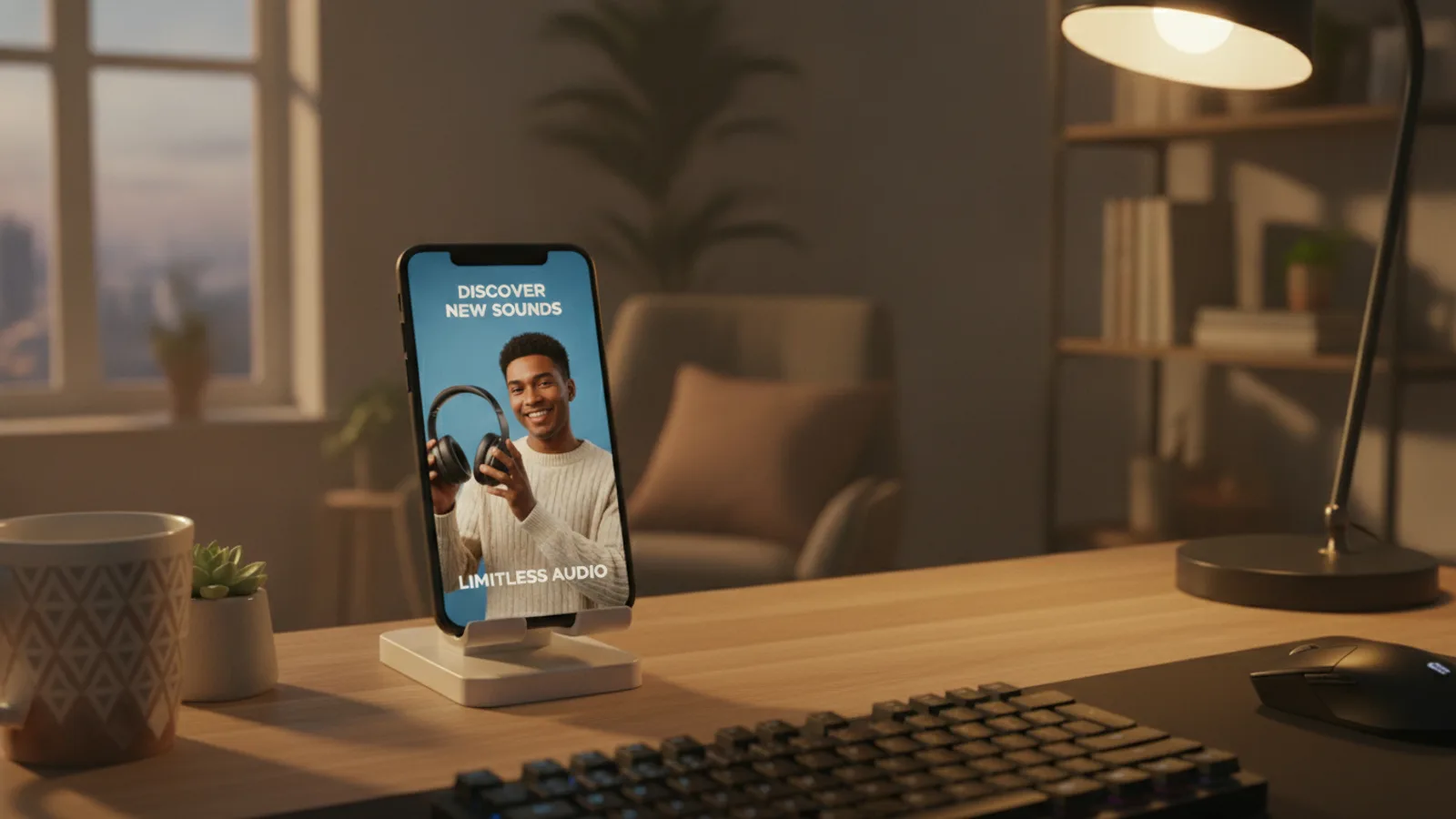
UGC ads are paid ads that look like a customer made them: a vertical phone video of a person holding the product and talking to the camera, run from the brand's ad account. They work because they look like the posts around them on TikTok, Reels and Shorts, and you can make them with real customers, hired creators or an AI UGC video ad maker that puts an AI creator in front of your product.
This guide covers what the term means, how a UGC ad differs from the other kinds of social ads, what goes into one, and the three ways to get them, with the trade-offs of each.
What "UGC ad" means
UGC is short for user-generated content: anything customers make about a brand, from a written review to an Instagram photo. In advertising the term narrowed. When a marketer says "UGC ad" or "UGC video" today, they almost always mean a format, not a source:
- a person on their phone, framed like a selfie or propped up on a shelf;
- talking in the first person, casually, as if to a friend;
- the product in their hand, shown in use in an ordinary room;
- vertical 9:16, with captions and a short card or two on screen.
Most UGC ads are not made by customers at all. They are commissioned from creators who are paid to make content that looks like a customer's, and the brand owns the right to run it as an ad. That is why "UGC creator" is now a job.
UGC ad vs influencer ad vs brand ad
| UGC ad | Influencer post | Polished brand ad | |
|---|---|---|---|
| Who posts it | The brand, from its ad account | The influencer, on their account | The brand |
| What it relies on | How natural it looks | The influencer's audience | Production value |
| Looks like | A customer's phone video | The influencer's usual posts | A commercial |
| Easy to make many versions | Yes | No | No |
The last row is the important one. Paid social rewards testing: several hooks, several angles, several lengths. A UGC ad is cheap to vary because nothing in it is precious: a new first line or a different room is a new version. The same logic applies to Instagram Reels ads, one of the feeds where UGC ads run.
Why UGC ads work
There is no magic in the format; it works for plain reasons:
- It blends in. Feeds are full of people talking to their phones. A video that looks like one gets the first second of attention that a logo and a jingle often lose.
- A face holds attention. Someone looking into the lens and talking reads as a person, not an ad.
- It shows instead of telling. The product is in a hand, in a real room, being used. The viewer can judge it for themself.
- It is built for sound-off and sound-on. Captions carry the message when the sound is off; the voice carries it when it is on.
What it can't do is make a claim true. A UGC ad that promises results the camera can't show reads as fake, and ad platforms restrict health, money and before-and-after claims in any format.
What goes into a UGC ad
Almost every UGC ad has three parts:
- The hook (first 2–3 seconds): one line, and an on-screen card of a few words. "Okay, honest take on…", "If X annoys you, watch this", "POV: …".
- The middle: the product named, held up with the label to the lens, and shown in use. One opinion per shot.
- The call to action: a few words, said and shown: "Link in bio", "Shop now".
The common angles are honest take, unboxing, problem → solution, three reasons and POV. The beat-by-beat versions, with hook formulas, are in UGC script templates and hooks; which angle suits which product is in UGC video examples by product type. For the look itself (the framing, light and room that make a video read as phone-shot) see UGC-style video.
Three ways to get UGC ads
1. Real customers. Reviews and videos customers post on their own. They are the most credible, but you can't brief them, you need their permission to run them as ads, and you can't order ten versions by Friday.
2. Hired UGC creators. The standard route: you send a brief and the product, the creator films and edits, and you buy usage rights. You get a real person and real reactions. The costs are in time and coordination: shipping the product, waiting for drafts, asking for reshoots, and negotiating again for each new version or market.
3. AI creators (UGC ads without creators). An AI UGC tool generates the person, the room and the voice from your brief. You can make as many versions as you want and in other languages, and nothing has to be shipped. The trade-offs: the person is not a real customer, the video should be labelled as AI-generated, and the tool should never put words in the presenter's mouth that you couldn't stand behind.
Many brands mix them: AI creators to find the hook and the angle that work, then real creators or customers for the winners.
How to make a UGC ad without hiring a creator
On Cinely's UGC video maker the brief is short:
- The product: its name, up to three product photos (the first one appears in every clip) and a description of up to 400 characters. That description is the only source of facts the creator may state.
- The creator: an AI creator from Cinely's library, or "Let Cinely pick" to match one to the product. The same face and voice stay in every clip. Your own face, a real person or a celebrity isn't supported.
- The angle: honest take, unboxing, problem → solution, 3 reasons, POV, or auto.
- Where it is filmed: bedroom, car, kitchen, bathroom, desk, outdoors, or auto.
- The length: 15, 30, 45 or 60 seconds, always vertical 9:16 with captions, in any of 17 languages.
Cinely writes the hook card, the spoken lines, the call-to-action card and a post caption with hashtags, and shows them in a free preview. Credits are spent only when you approve: 30 per 8-second clip in Standard, 60 in Cinematic (Cinematic needs Premium). A 15-second ad is 60 credits in Standard, 30 seconds 120, 60 seconds 240. A clip that fails is refunded. Credit packs and Premium are on the credits page.
The script stays honest by design. The creator gives opinions and shows the product; it never states a personal result the clip can't show, a customer or doctor testimonial, a medical, health or financial claim, a comparison with a named competitor, or "guaranteed" and "number one". If your brief gives no numbers, the creator describes what is visible. The acceptable use policy applies to every video, and you should mark the ad as AI-generated where you post it.
For the full walkthrough, from product photo to finished ad, read AI UGC ads from one product photo. If you would rather have the product as the star, with no presenter, the AI ad video maker makes a voiced product ad instead.
A quick checklist before you run a UGC ad
- The hook works with the sound off (the card says it too).
- The product is in the frame by the second shot, label readable.
- Every claim is something you can prove, or something the viewer can see.
- One call to action, the same one in the voice, the card and the caption.
- The ad is labelled as AI-generated if it is, and as a paid partnership if a creator posts it.
- You made more than one version: at least two hooks, ideally two angles.
When you're ready, try a 15-second version first: it is the cheapest way to test a hook with AI UGC ads, and the one that holds attention is the one worth extending to 30.
- What does UGC ad mean?
- UGC stands for user-generated content. A UGC ad is a paid ad that looks like content a customer made: usually a vertical phone video of a person holding the product and talking straight to the camera. Most UGC ads are made on purpose for the brand, by a hired creator or, increasingly, by an AI creator.
- What is the difference between a UGC ad and an influencer ad?
- An influencer ad is posted on the influencer's own account and relies on their audience. A UGC ad is handed to the brand, which runs it from its own ad account to whoever it targets. The creator's following does not matter; only how natural the video looks and sounds does.
- Can you make UGC ads without creators?
- Yes. With an AI UGC video ad maker such as Cinely's, an AI creator from a library holds your product (from a product photo) and talks to the camera in a vertical 15 to 60 second video with captions. The script is shown free before you approve, and a 30-second ad is 120 credits in Standard. Label it as AI-generated where you post.
- How long should a UGC ad be?
- Most UGC ads run 15 to 30 seconds: 15 seconds is enough for a hook and a call to action, 30 seconds adds a demo. Unboxings and products with several features can use 45 to 60 seconds.
Written with AI assistance and edited by the Cinely Team.